
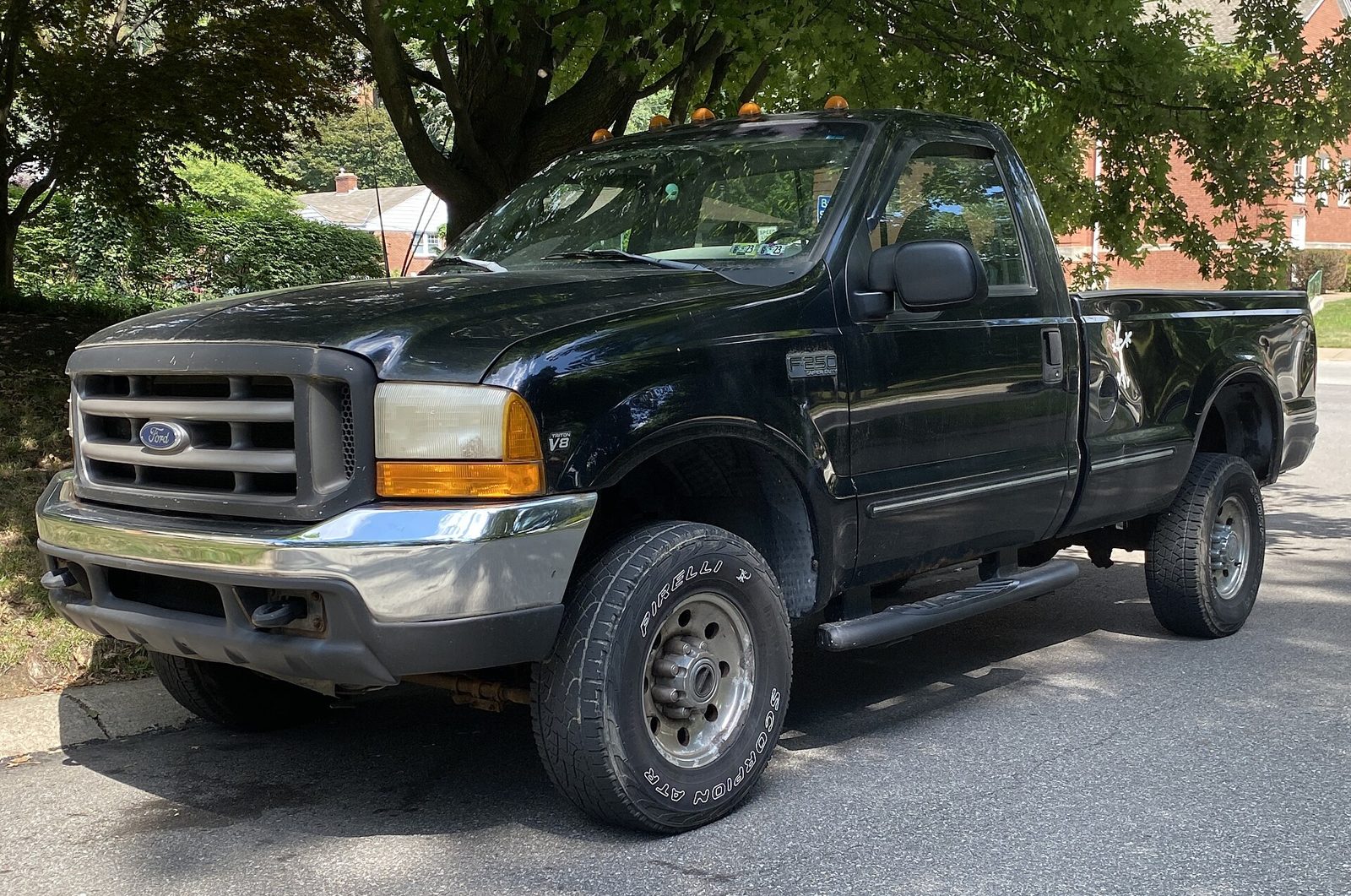
The 7.3L Power Stroke has a reputation as one of the toughest diesels Ford ever bolted into a pickup, and it mostly earned it. The bottom end is stout, there’s no EGR, no DPF and no DEF tank, and plenty of these trucks have rolled past 300,000 miles. But “tough” isn’t the same as “trouble-free.” After 20-plus years, the same handful of parts keep showing up on shop benches and forum threads.
The good news is that almost none of them are engine killers, and most are well within reach of a driveway mechanic with decent hand tools and a little patience. Below are the nine problems that come up most often on 1994-2003 7.3L trucks, Excursions and vans, how to tell which one you’ve got, and how to fix it.
A quick word on the two generations. The 1994.5-1997 trucks are the “OBS” (old body style), and 1999-2003 trucks are the Super Duty. The engine is the same family, but a lot of parts differ: up-pipes, the turbo pedestal, the fuel bowl, injectors and some sensors. Always check fitment by year and VIN before you order anything.
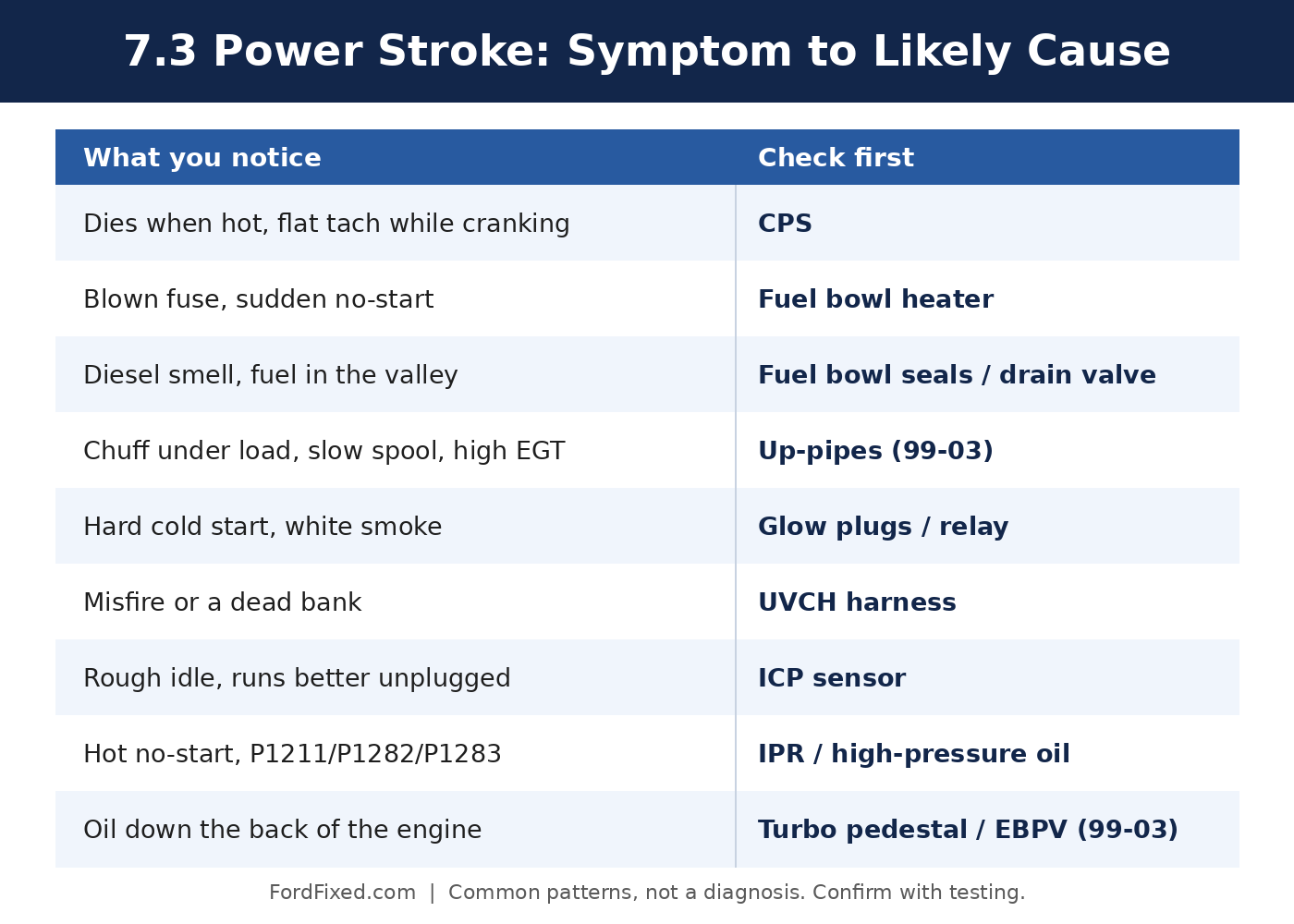
1. Camshaft position sensor (CPS)
If the 7.3 had a mascot, it would be the CPS. It’s the part old-timers tell you to keep in the glovebox, and they’re not kidding. The sensor bolts to the front cover and reads the cam, and without its signal the computer has no idea the engine is turning, so it won’t fire the injectors.
Symptoms
- Engine dies while driving, often once it’s fully warm, then may restart after it cools off a bit
- Cranks and cranks but won’t start
- Sometimes a P0340 or P0344 code, sometimes nothing at all
Diagnose it
The classic test: watch the tachometer while you crank. A healthy 7.3 shows a little tach movement during cranking. If the needle stays flat on zero, the CPS is the prime suspect (Dead Head Diesel and Bostech both lead with this test).
Fix it
- Disconnect the battery negative cables (yes, both of them).
- Find the sensor on the driver side of the front cover, behind the pulleys. Some owners pull the serpentine belt for room.
- Unplug the connector and remove the single 10mm bolt. Use a good 6-point socket. Rounded bolt heads on these are a known headache.
- Install the new sensor with a light film of clean oil on the O-ring, torque the bolt snug (don’t lean on it), plug it in and start the truck.
- Look at the pigtail while you’re there. If it’s oil-soaked or brittle, replace it too.
Parts: A genuine Motorcraft DU-87 cam position sensor. Owners on TheDieselStop note that the DU-87 (F4TZ-12K073-C) was the 1994-1996 part and F7TZ-12K073-B is listed for later trucks, but many owners run the DU-87 on later engines too. Check your engine serial number, and skip the bargain no-name sensors. You want this one to last longer than the drive home.
2. Fuel bowl heater shorting out
The fuel filter housing (everyone calls it the fuel bowl) sits in the valley on top of the engine, and there’s an electric heater element at the bottom to keep diesel from gelling in winter. When that element shorts, it can blow a fuse and leave you with a no-start or a stall.
Symptoms
- Sudden no-start or stall, sometimes with a blown fuse
- Odd electrical gremlins that line up with cold mornings
- Fuse blows again right after you replace it
Diagnose and fix
- Check the fuses for the fuel heater circuit (your owner’s manual or the fuse panel cover shows which one). A fuse that keeps blowing points at the heater or its wiring.
- Unplug the heater connector at the bowl and see if the fuse holds and the truck starts. If it does, you’ve found it.
- Drain the bowl, pull the filter and remove the heater element from the bottom of the housing.
- Install a new element with fresh seals, reconnect, refill and prime the system.
Some owners in warm climates leave the heater unplugged, as BD Diesel mentions, but if you see real winters, replace it. The Dorman 904-210 fuel bowl heater is Dorman’s updated version for 1994-2003 7.3L trucks.
3. Fuel bowl leaks and the drain valve
Same housing, different problem. The fuel bowl uses a stack of O-rings and gaskets, and after a couple decades of heat cycles they harden and leak. On Super Duty trucks, the water drain valve at the back of the bowl is the usual culprit.
Symptoms
- Diesel smell after a drive
- Fuel puddling in the valley or dripping off the back of the engine
- Long cranking after the truck sits, because air got into the fuel system
Fix it
If it’s only the drain valve, a drain valve rebuild with new O-rings is the cheap, quick fix. If it’s leaking from the upper seals, you’re looking at a full bowl reseal kit, and a cracked housing means replacement (Bostech lays out these levels well). Whatever you do, put in a new fuel filter while it’s apart. For 1999-2003 trucks, that’s a Motorcraft FD-4596 fuel filter. OBS trucks use a different filter, so check yours before you order. For the drain valve, the Dorman 904-020 drain valve O-ring kit fits 1999-2003 trucks, and the Alliant Power drain valve seal kit covers 1994-1997 OBS trucks.
4. Leaking up-pipes (1999-2003 Super Duty)
The up-pipes carry exhaust from the manifolds up to the turbo. On Super Duty trucks they seal with crush gaskets (“donuts”) and slip joints that eventually give up. Exhaust that leaks out before the turbo is energy that never spins the turbo.
Symptoms
- A chuffing or hissing sound from the engine bay under load
- Slow spool, weak low-end power
- Higher EGTs than normal and black soot streaks around the manifold joints
Diagnose and fix
Look for soot trails at the manifold-to-pipe joints with the engine cold. Listen for the chuff while someone else revs it. The cheap fix is new donut gaskets. The fix that tends to stick is a set of bellowed one-piece up-pipes, and since it’s a lot of the same disassembly, many folks do this while the turbo is off for the pedestal reseal (#9). Sources: Dead Head Diesel, Bostech. For 1999.5-2003 trucks, the Dorman 679-005 bellowed up-pipe kit is a common pick. It does not fit early 1999 trucks with the small-case turbo.
Bring penetrating oil and patience. Twenty-year-old exhaust bolts don’t come out because you asked nicely.
5. Glow plugs and the glow plug relay
Diesels light their fuel with compression heat, and glow plugs help that along on cold starts. The 7.3 has eight plugs and a big relay on the driver side valve cover that feeds them. Plugs tend to die one at a time. The relay usually goes all at once.
Symptoms
- Hard starting in cold weather that gets worse as temps drop
- White smoke and a rough idle until it warms up
- Wait-to-start light comes on, but the plugs don’t seem to be getting power
Diagnose it
- Relay: With the key on, the relay should click and you should see voltage on both large terminals. A test light works fine for this (RD2FS no-start flowchart). Voltage in but not out means a bad relay.
- Plugs: Ohm-check each plug. Bostech puts a healthy plug at roughly 0.5-2 ohms; an open circuit (infinite resistance) means it’s dead.
Fix it
Replace the relay with a quality part like the Dorman 904-194 glow plug relay. If one or two plugs test bad, replace all eight while you’re in there. The valve covers have to come off, and you don’t want to do that twice. Genuine Motorcraft ZD-11 glow plugs (now superseded by ZD-30) are the safe bet, and you need eight.
6. Under valve cover harness (UVCH)
Inside each valve cover there’s a wiring harness that feeds the injectors and glow plugs. It lives in hot oil for decades, and the connectors at the valve cover gasket can loosen, corrode or cook.
Symptoms
- Misfire that comes and goes, sometimes worse when hot
- A dead bank (four cylinders quit at once)
- Injector circuit codes that bounce between cylinders, or one glow plug that never seems to work
Diagnose and fix
Unplug the connectors where they pass through the valve cover gaskets and look for melted plastic, burnt pins or pushed-back terminals. While you have them apart, ohm-check the glow plugs and injector circuits. If the harness is cooked, replace it, plus the gasket connector, and use updated retaining clips so the plugs can’t back out (BD Diesel, Bostech). Since this is the same job as glow plugs, doing both at once is just good planning. Michigan Motorsports sells the gasket and harness as kits: one for mid-1994 to mid-1997 trucks and one for 1997.5-2003 trucks. Ford changed the valve cover wiring during 1997, so on a 1997 truck count the connectors on each valve cover before you order.
7. ICP sensor
The injection control pressure sensor screws into the driver side head and tells the computer how much high-pressure oil it has for the injectors. Its internal seals give up over time and oil wicks into the connector.
Symptoms
- Rough idle, surging or stalling
- Hard starts, especially when hot
- Codes like P1280 or P1281
Diagnose it
Two easy checks. First, pull the connector and look inside. Oil in there is a pretty clear sign, and it can wick up and damage the pigtail. Second, with the engine running, unplug the sensor. The computer falls back to a default value, and if the truck suddenly runs better, the sensor is bad (Dead Head Diesel, Bostech).
Fix it
Replace the sensor and the pigtail together if you found oil in the connector. It’s a 15-30 minute job. Stick to Motorcraft or International parts here. The genuine Ford F6TZ-9F838-A ICP sensor is the Ford part number for the Motorcraft CM-5227. Confirm it matches your truck by VIN.
8. IPR valve sticking and high-pressure oil leaks
The 7.3 fires its injectors with engine oil at high pressure, not fuel. The injection pressure regulator (IPR) on the back of the high-pressure oil pump controls that pressure. If it sticks, or if the system leaks, the engine can’t build enough pressure to fire the injectors.
Symptoms
- Hard starting hot, or crank-no-start with a good CPS
- Surging idle, low power
- Codes like P1211, P1282 or P1283, and oil showing up in the valley
Diagnose and fix
A scan tool that reads ICP and IPR duty cycle is very helpful here. If the IPR is sticking, the common first step is to pull it, clean the screen and armature, and reinstall with new O-rings. Bostech lists 35 ft-lb for the valve body and 53 in-lb for the solenoid nut, but check your service manual too. You’ll need to remove the fuel bowl for access. For leaks, degrease the valley, run the engine and watch where fresh oil appears. On Super Duty trucks, the high-pressure fittings are a common leak point. If the IPR itself is bad, the Alliant Power IPR valve for 1995-2003 7.3L is a common replacement. Confirm the part for your year before you order.
Safety note: this system runs at thousands of PSI. Never loosen high-pressure oil parts with the engine running, and keep your hands away from any pinhole leak. High-pressure oil can go through skin.
9. Turbo pedestal and EBPV oil leaks (1999-2003)
On Super Duty trucks the turbo sits on a cast pedestal that also routes oil and, on most of them, holds the exhaust back pressure valve (EBPV), which helps the engine warm up. The pedestal O-rings harden and leak, and the EBPV can stick or leak too.
Symptoms
- Oil running down the back of the engine, often mistaken for a rear main seal leak
- Burning oil smell after shutdown
- Odd cold-idle behavior if the EBPV sticks
Fix it
The turbo has to come off, so do everything at once: new pedestal and turbo O-rings (Viton is the usual upgrade), check the turbo shaft for play, and replace the up-pipes or donuts (#4) while there’s room. Some owners swap to a pedestal without the EBPV. If you go that route, check your local emissions and inspection rules first (Bostech). Plan for a full Saturday and a big drip pan.
Honorable mention: the IDM
The injector driver module on the driver side fender does the high-voltage work for the injectors. When water gets in or it fails, you can get a crank-no-start even though the CPS is fine and the tach moves. It didn’t make the main list, but it’s worth checking when the usual suspects come up clean.
A simple no-start game plan
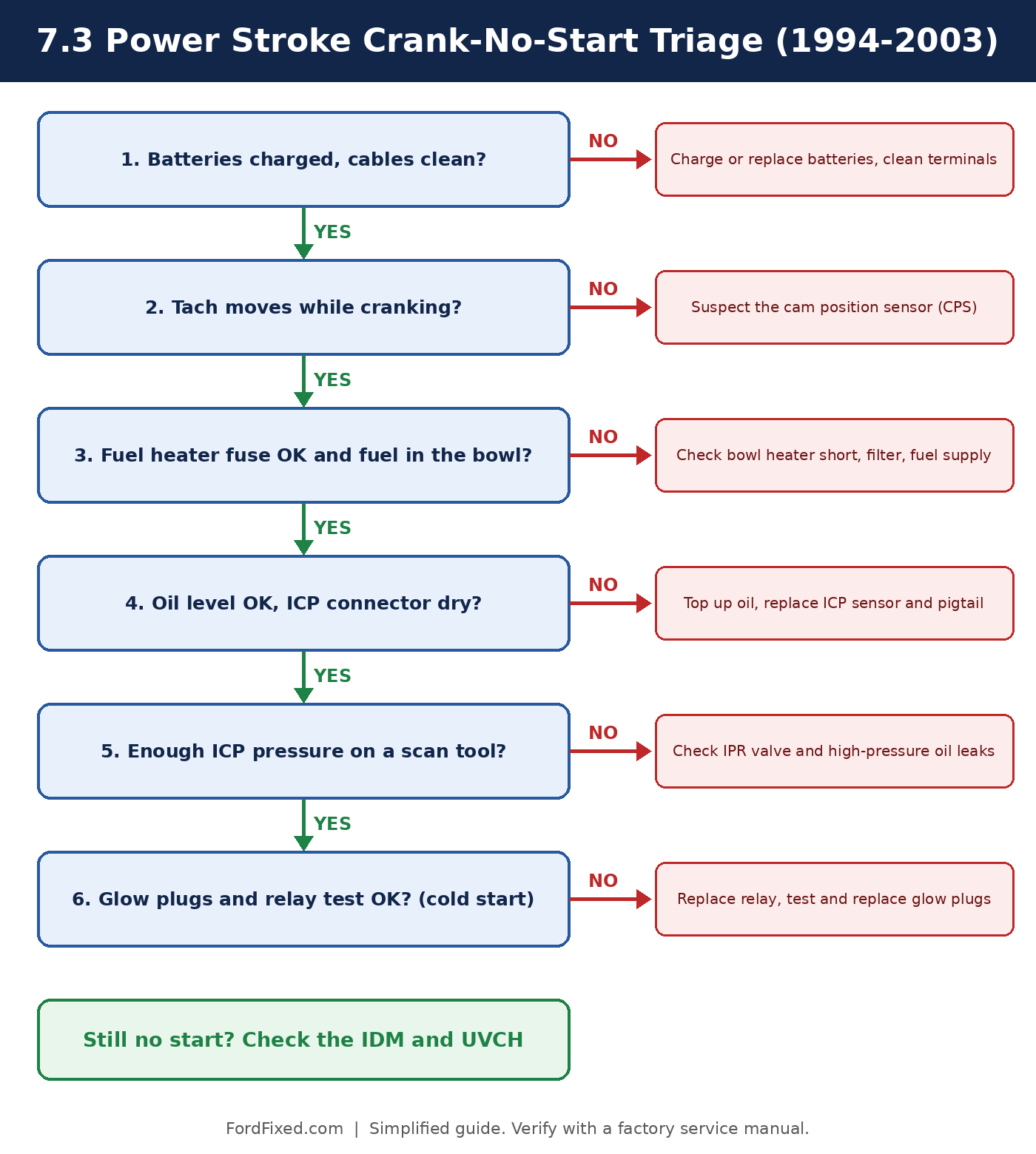
- Batteries charged and connections clean? (The 7.3 is hungry when cranking.)
- Tach moving while cranking? If not, CPS.
- Fuel bowl heater fuse OK? Fuel in the bowl?
- Oil level OK? Then check ICP and IPR, since the injectors need high-pressure oil.
- Still nothing? Check the IDM and the UVCH connectors.
Most of these jobs can be done in a driveway in a day or less. Keep a spare CPS, a 10mm socket and a jug of 15W-40 behind the seat, and the old 7.3 will probably outlive the truck around it.
Sources
- Bostech: 7.3L PowerStroke Common Problems owner diagnosis and repair guide
- Dead Head Diesel: Fixing common 7.3 Powerstroke problems
- BD Diesel: 7.3L Power Stroke 10 common issues and real fixes
- TheDieselStop forum: Motorcraft DU-87 cam position sensor discussion
- RD2FS Performance: 7.3L Powerstroke crank no-start troubleshooting flowchart (PDF)
This article is for informational purposes. Verify part numbers by VIN and follow a factory service manual for specs and safety procedures. As an Amazon Associate, Ford Fixed earns from qualifying purchases.