
If the 7.3 Power Stroke is the diesel people brag about, the 6.0 is the one people warn you about at the parts counter. Fair enough. From 2003 through 2007, Ford stuffed this International-built V8 into Super Duty pickups, Excursions and vans, and a short list of weak spots earned it a permanent reputation.
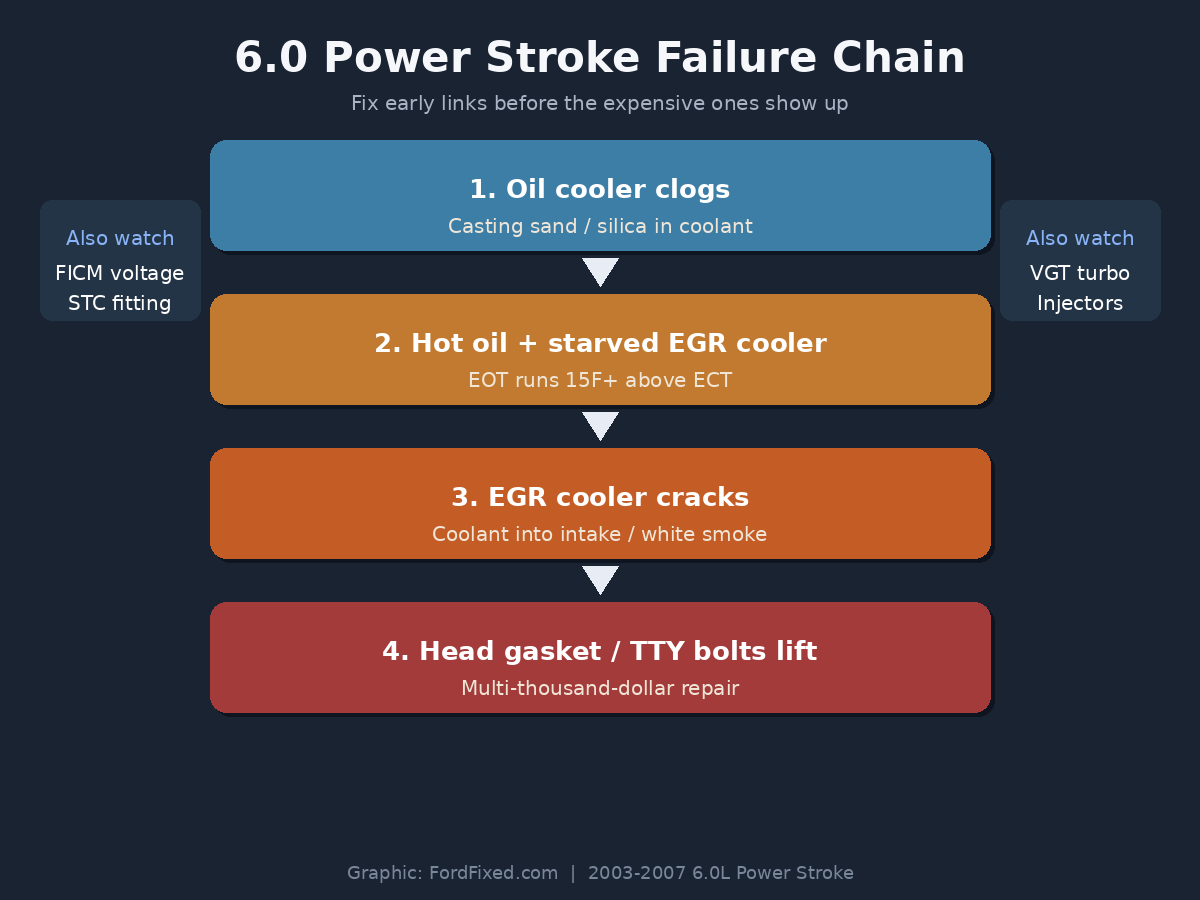
Here is the part most “6.0 is junk” rants skip: the failures usually follow a chain. Catch the early links and the truck can tow for a long time. Ignore them and you end up buying heads, coolers and a second mortgage in the same week. Below are the problems that show up most often, how they connect, and what to check first. For the older bulletproof brother, see our 7.3 Power Stroke common problems guide.
1. Oil cooler: the first domino
The stacked-plate oil cooler lives in the front of the lifter valley. Coolant passages are tiny, and leftover casting sand plus silica from old gold coolant slowly choke them. When the cooler restricts, engine oil temperature climbs and coolant flow to the EGR cooler drops. That is the starting gun for most major 6.0 repairs (Bostech, Alligator Performance).
Watch for: engine oil temp (EOT) running about 15°F or more above coolant temp (ECT) on a highway cruise. Log both with a scan tool before you throw parts at the truck.
Do this first: flush the cooling system properly, then add a coolant filtration kit so debris stops recirculating. A kit like the Mishimoto MMCFK-F2D-03 coolant filter kit for 2003-2007 6.0L is a common driveway install. And use a real Motorcraft FL-2016 oil filter (3C3Z-6731-AA). Cheap filters shed media that can trash the IPR and high-pressure oil system.
2. EGR cooler and EGR valve
Once the oil cooler is restricted, the EGR cooler often cracks. Coolant leaks into the intake, you see white smoke, and in a bad case the engine can hydrolock. The EGR valve itself also cakes up with soot and sticks open or closed, which kills drivability even when the cooler is still intact. Early 2003 round coolers hold up better than the later square design, but neither likes a starved oil cooler.
Symptoms: unexplained coolant loss, sweet smell, white smoke under load, or a truck that runs like it is smothered. Fix the oil cooler path before or with the EGR cooler, or you will be buying coolers twice.
3. High-pressure oil system and the STC fitting
Like the 7.3, the 6.0 fires injectors with high-pressure engine oil (HEUI). Internal O-ring leaks, standpipe issues, and a failed high-pressure oil pump show up as hard starts or no-starts when hot, or a sudden loss of power. On 2005-2007 engines, the snap-to-connect (STC) fitting in the high-pressure oil system is a known weak point. If yours is still original, plan on the updated fitting before it leaves you stranded (Diesel IQ, Alligator Performance).
Safety note: high-pressure oil can pierce skin. Never crack fittings with the engine running, and treat any pinhole leak like a hazard, not a drip.
4. FICM, batteries and injectors
The fuel injection control module sits on the driver-side valve cover and boosts battery voltage to fire the injectors. Weak batteries and a tired alternator cook FICMs. Low FICM voltage looks a lot like bad injectors: hard cold starts, rough running, lost power. Check battery health and FICM voltage on a scan tool before you order a set of injectors. The injectors themselves do stick (stiction) when oil quality is poor or change intervals stretch, but electrical supply is the cheap check that gets skipped too often.
5. VGT turbo and head gaskets
The variable-geometry turbo uses vanes that stick from soot or rust. You get overboost, no boost, or weird surge. Cleaning or replacing the turbo is common high-mileage work. Head gasket failures are the nightmare ending: four torque-to-yield bolts per cylinder stretch, especially under heavy load or after the cooling cascade above, and clamping force disappears. ARP studs are the usual upgrade when the heads come off (MotorTrend).
A practical game plan
- Log EOT vs ECT, FICM voltage and fuel pressure before buying parts.
- If EOT is high, service the oil cooler and add coolant filtration.
- Confirm batteries and charging before condemning the FICM or injectors.
- On 2005-2007 trucks, budget for the updated high-pressure oil STC fitting.
- Change both fuel filters on schedule. Motorcraft FD-4616 is the updated bowl/filter set for these trucks. Buy from a trusted Motorcraft source; counterfeits show up online.
The 6.0 is not a 7.3. It needs data, clean coolant, healthy batteries and honest filters. Give it that and it stops being a punchline and starts being a tow rig again.
Sources
- Bostech: 6.0L PowerStroke Common Problems (2003-2007)
- Alligator Performance: 6.0L Power Stroke Maintenance Buyer’s Guide
- Diesel IQ: Ford 6.0 Powerstroke Common Problems
- MotorTrend: Ford 6.0 Power Stroke Diesel Engine overview
This article is for informational purposes. Verify part numbers by VIN and follow a factory service manual for specs and safety procedures. As an Amazon Associate, Ford Fixed earns from qualifying purchases.