If your newer Ford bangs into gear, flares between shifts, or hesitates when you pull into Drive, you are not imagining it. A lot of late-model F-150s, Mustangs, Expeditions, Explorers, Rangers, and Transits use Ford’s 10-speed 10R80 automatic (and a hybrid cousin called 10R80 MHT). It can shift great when healthy. When it is unhappy, owners usually notice harsh engagement, delayed shifts, slip or flare, cold-weather drama, and sometimes a check-engine light with shift-related codes.
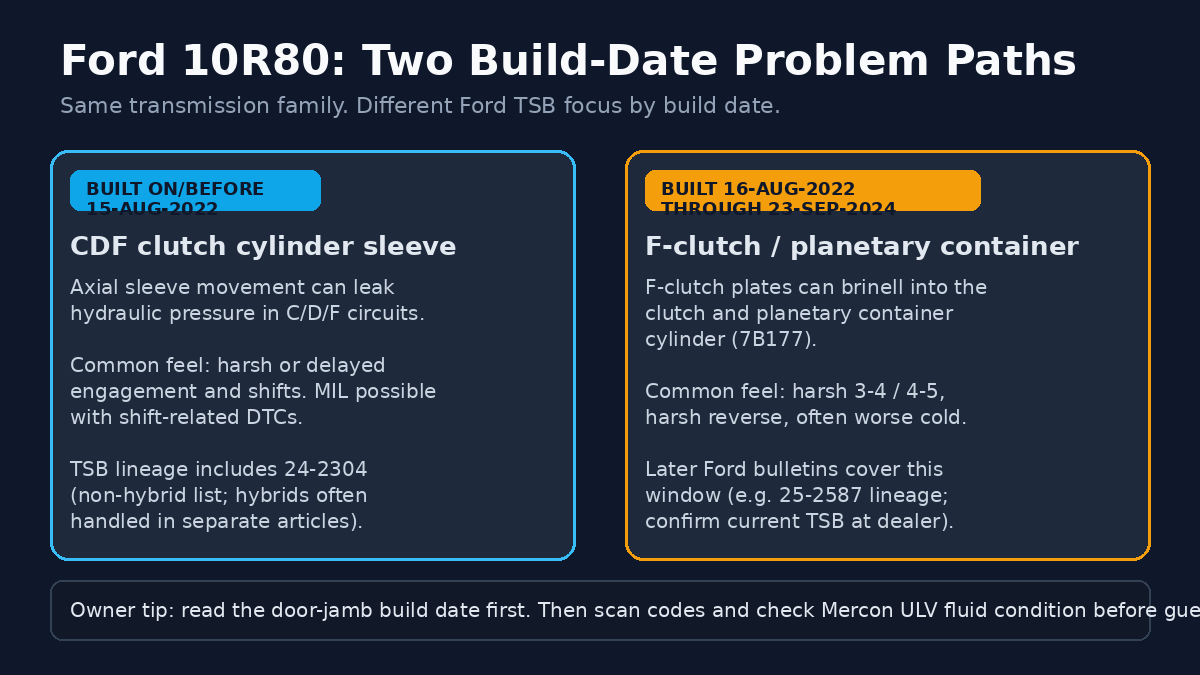
The useful part: Ford’s own technical service bulletins split the story by build date, not by vibes. Check the sticker on the driver door jamb before you start quoting parts counters.
Build on or before 15-Aug-2022: CDF clutch cylinder sleeve
On several non-hybrid 10R80 applications built on or before 15-Aug-2022, Ford TSB 24-2304 (it supersedes earlier CDF articles such as 24-2254) blames harsh or delayed engagement and shifts on axial movement of the CDF clutch cylinder sleeve (part family 7H351). When that sleeve walks, hydraulic circuits for the C, D, and F clutches can leak pressure. The bulletin lists vehicles that include 2021-2022 F-150 and Mustang, 2020-2022 Explorer, 2020-2023 Transit, and 2022 Expedition/Navigator, and it explicitly excludes hybrids in that CDF write-up. Related DTCs can include a long list of clutch and gear-ratio codes (P0751-series, P2700-series, and others named in the bulletin).
Dealer repair path: pressure testing and, if it fails, transmission teardown to replace the CDF cylinder plus seals as required. This is not a driveway job. Aftermarket “CDF drum saver” style kits exist for rebuilders, but they are not a DIY weekend fix for most owners.
Built 16-Aug-2022 through 23-Sep-2024: F-clutch container wear
Trucks and SUVs built after the mid-August 2022 cutoff got updated CDF hardware in Ford’s story. A later concern shows up on units built from 16-Aug-2022 through 23-Sep-2024: harsh 3-4 and 4-5 upshifts, harsh 5-3 and 4-3 downshifts, and harsh reverse, often worse when cold. Ford attributes that to F-clutch friction plates brinelling into the clutch and planetary container cylinder (7B177). NHTSA-hosted bulletin text in that lineage includes 25-2587, with later updates reported in the field as 26-2241. Ask the dealer which article currently applies to your VIN rather than arguing TSB numbers at the parts counter.
That later bulletin set covers a wider model list than the older CDF article, including 2022-2024 F-150 (gas and MHT in the text we reviewed), Expedition, Explorer, Mustang, Transit, plus Ranger and Lincoln cousins in the same build window. Repair is still internal: F-clutch steels and frictions plus the 7B177 container, seals, and an adaptive relearn afterward.
What to do first (owner path)
- Read the door-jamb build date and write it down.
- Scan for PCM/TCM codes even if the light is off. Freeze-frame helps.
- Confirm fluid is Motorcraft Mercon ULV only (XT-12-QULV). Wrong fluid in a 10R80 is an expensive way to learn chemistry. Top-off and service work should stick to ULV; see Motorcraft Mercon ULV (XT-12-QULV) when you need quarts with clear 10R80 fitment.
- If symptoms match a current TSB for your build date, start with the dealer under warranty or ESP. If you are out of coverage, a transmission shop that actually rebuilds 10R80s beats a generic fluid flush.
Not every harsh shift is a death sentence. Software, adaptive learning after battery work, valve-body issues, and plain neglected fluid still exist. The build-date split just keeps you from chasing the wrong drum while the right one is chewing itself.