You walk out on a chilly morning, fire up your F-150, and for two or three seconds the engine sounds like somebody shook a coffee can full of bolts. Then it settles down and idles like nothing happened. If you own a 3.5 EcoBoost, congratulations, you’ve met the most famous noise in modern Ford truck history.
The question everyone asks next is simple: is it the timing chain or the cam phasers? The honest answer is “it depends on which year you have,” and that’s not me dodging. Ford wrote separate service bulletins for the first-generation engine (2011-2016 trucks) and the second-generation engine (2017-2020), and the fixes are different. Below I’ll walk through what each bulletin actually says, why the year split exists, how to tell the two problems apart, and what to check before you buy a used one.
Quick answer: On 2011-2015 trucks built on or before May 29, 2015, Ford’s fix for the cold-start rattle replaces all four cam phasers and the primary timing chain. On 2017-2020 trucks built on or before October 31, 2019 (later extended to November 30, 2019), Ford blames worn cam phasers and replaces all four, plus a computer update, and specifically says not to replace timing chains unless inspection shows a problem.
What that rattle actually is
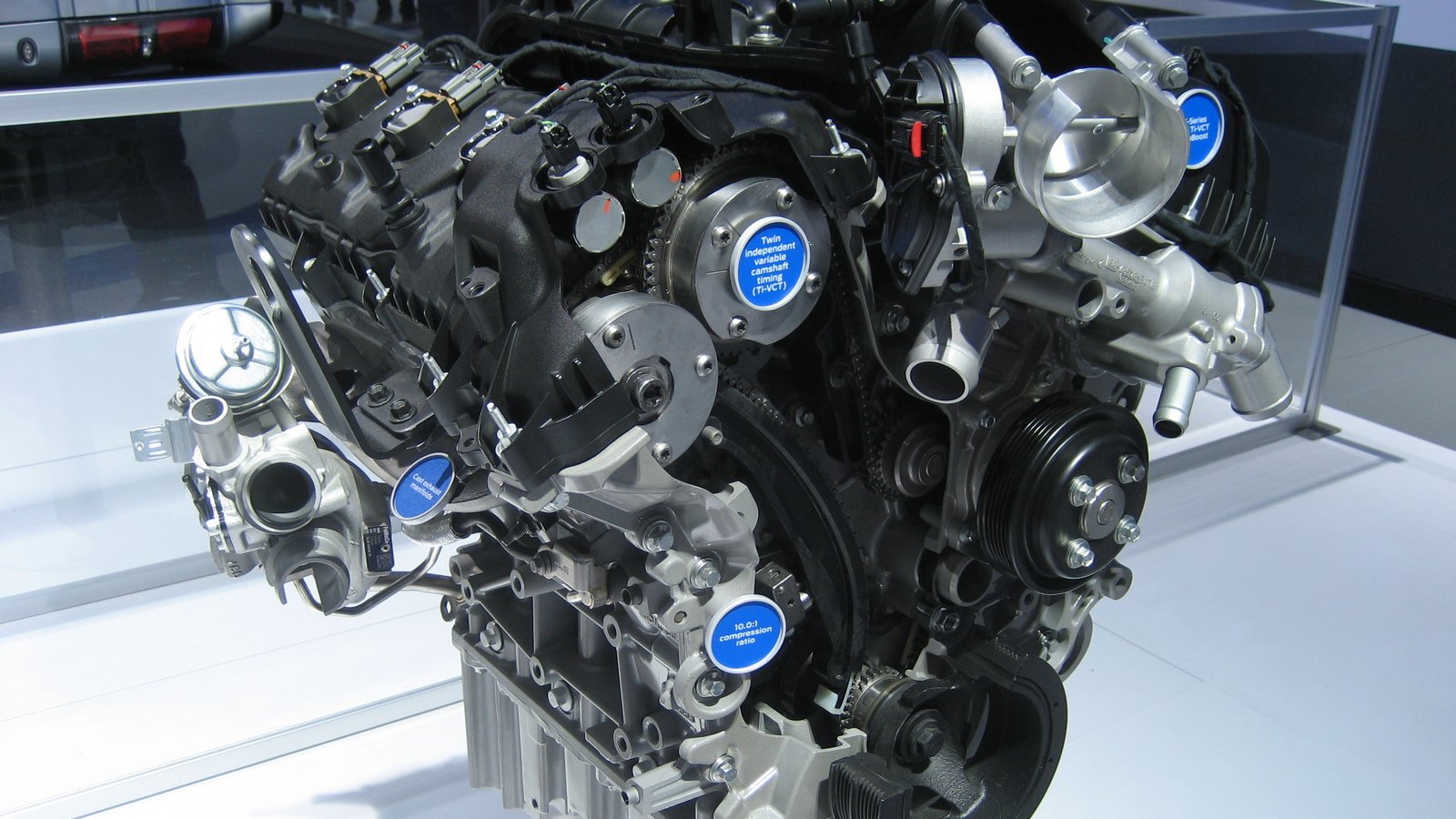
The 3.5 EcoBoost has four cam phasers, one on the front of each camshaft. Ford calls them variable camshaft timing (VCT) units. They’re oil-pressure-operated gadgets that twist each cam a few degrees ahead or behind to help power, fuel economy and emissions. The timing chain(s) spin them; the phasers fine-tune the timing.
Here’s the catch. After a truck sits for several hours, oil drains away from the top of the engine. On startup there’s a short window before full oil pressure reaches the phasers and the chain tensioner. If a phaser is worn or the chain has stretched and gotten sloppy, parts can slap around for those first few seconds. That’s your rattle. Once oil pressure shows up, things firm up and the noise goes away, which is exactly why so many owners shrug it off for months.
Ford’s own description in every one of these bulletins is nearly word for word: a ticking, tapping or rattle-type noise from the top front cover area, lasting 2-5 seconds on startup after a cold soak of 6 hours or more. So if your truck does that, you’re in the right place.
The year split: two engines, two different bulletins
This is the part that confuses people on forums, so let’s lay it out cleanly.
2011-2015 F-150: TSB 18-2305 (built on or before May 29, 2015)
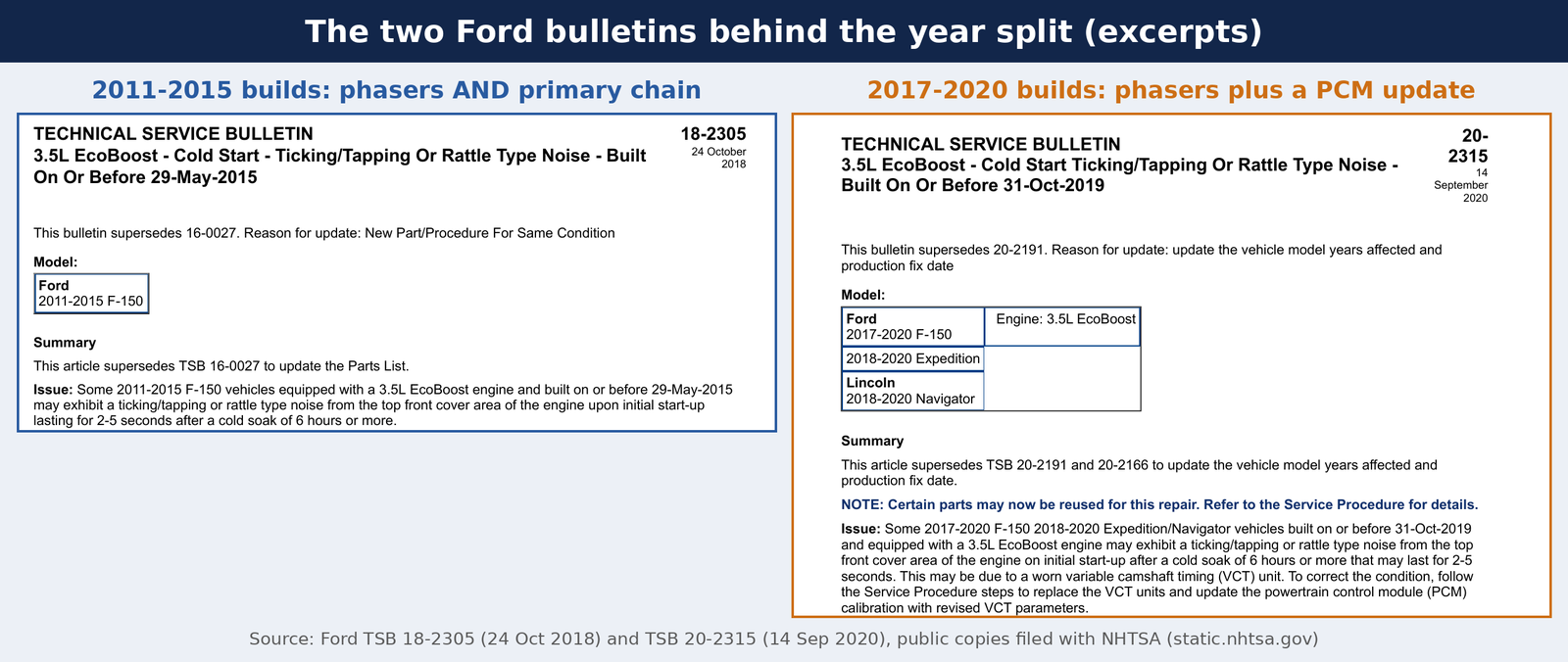
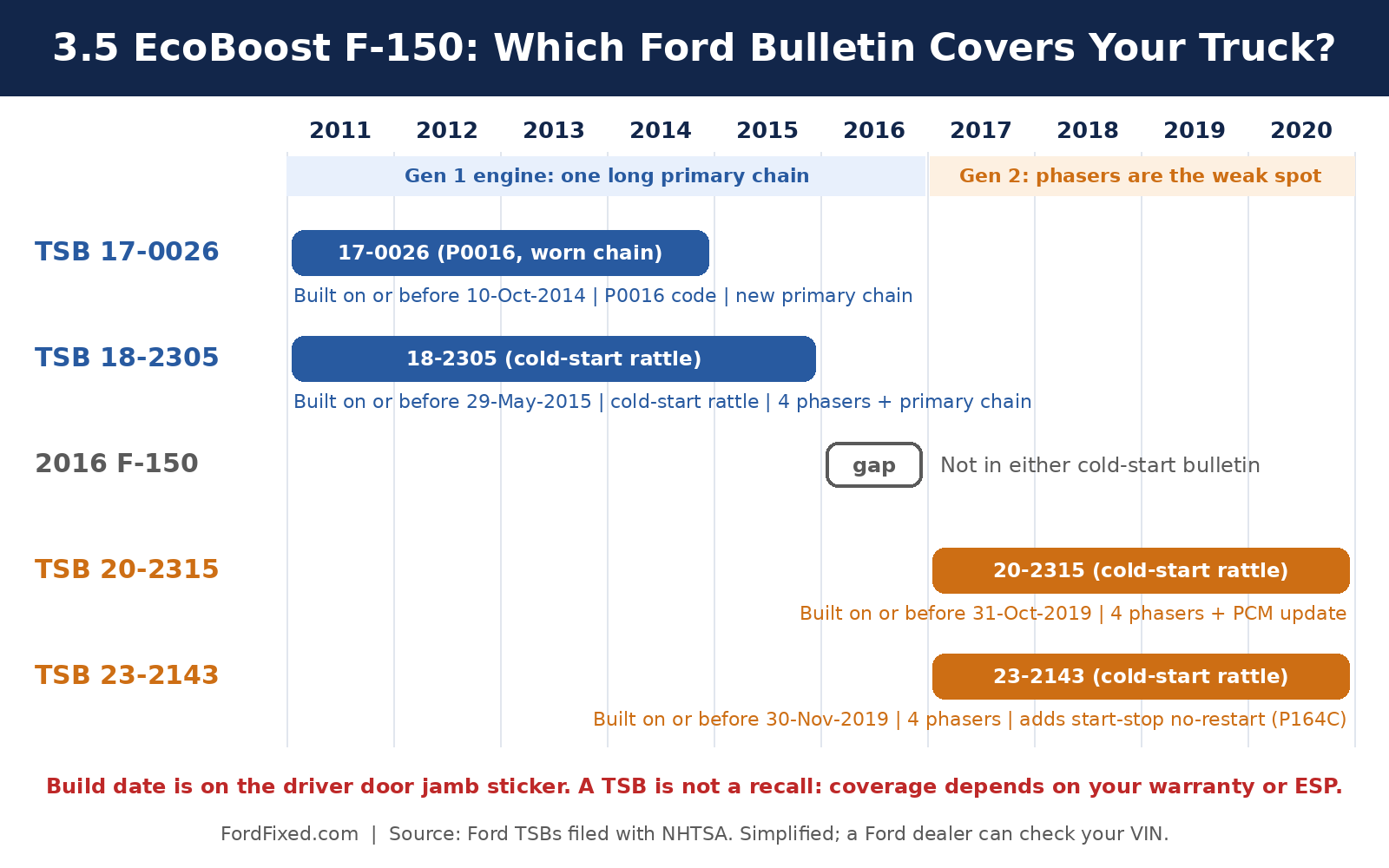
Ford TSB 18-2305 (October 24, 2018, which supersedes the earlier 16-0027) covers 2011-2015 F-150s with the 3.5 EcoBoost built on or before 29-May-2015. The repair: replace all four VCT units and the primary timing chain, using Ford’s timing chain tensioner kit (BL3Z-6D256-C). Ford’s labor allowance is 9.2 hours for 2011-2014 trucks and 9.0 hours for 2015.
There’s also an earlier, related bulletin. TSB 17-0026 covers 2011-2014 F-150s built on or before 10-Oct-2014 that set a check engine light with code P0016, and says the cause may be a worn primary timing chain. It’s a chain-only repair (8.9 hours), and the technician has to confirm a cam timing reading of +6 degrees or more before Ford pays for it.
2017-2020 F-150 (plus Expedition and Navigator): TSB 20-2315 (built on or before Oct 31, 2019)
For the second-generation engine, Ford TSB 20-2315 (September 14, 2020) covers 2017-2020 F-150s and 2018-2020 Expeditions and Navigators built on or before 31-Oct-2019. Ford says the noise “may be due to a worn variable camshaft timing (VCT) unit.” The fix replaces all four VCT units and updates the powertrain control module (PCM) with revised VCT parameters. Labor is 9.7 hours on a regular F-150 and 9.9 on a Raptor.
Ford kept refining this one. The later TSB 23-2143 (May 4, 2023) pushed the build cutoff to 30-Nov-2019 and added a second symptom: some trucks may fail to restart during auto start-stop, with or without code P164C. Its fix is still all four phasers, at 9.6 hours for an F-150 and 9.7 for a Raptor. Ford’s dealer portal now marks 23-2143 as superseded or deactivated too, so ask your dealer to pull whatever the current version is for your VIN.
So why does the old engine get a chain and the new one doesn’t?
Because the weak spot moved. The first-generation 3.5 uses one long primary chain to drive both cylinder banks. As the pins wear, every link grows a tiny bit, and across a chain that long it adds up enough to throw off cam timing. The engine rebuilders’ association AERA describes exactly this in a technical bulletin on 2011-2014 3.5 EcoBoost engines: a stretched primary chain is a common cause of P0016, and the fix is a new chain. Since a stretched chain and tired phasers make similar noises on that engine, Ford’s cold-start fix simply replaces both.
For 2017 Ford reworked the engine, including the timing drive, and chain stretch complaints dropped way off. The phasers became the noisy part instead. Ford’s interim service message (SSM 48168) is blunt about it: replace all four VCT units, update the PCM, and “do not replace timing chains, tensioners, guides or other timing related components unless inspection clearly identifies a concern.”
The build dates (May 29, 2015 and October/November 2019) are what Ford calls production fix dates. In plain English, that’s roughly when the improved parts went into trucks on the assembly line, so trucks built after those dates aren’t covered by that bulletin.
What about 2016? A 2016 F-150 still has the first-generation engine, but it was built after the May 2015 cutoff and before the 2017 redesign, so neither cold-start bulletin names it. That doesn’t make 2016 immune. It just means a dealer diagnoses it the normal way, without a bulletin to lean on.
Chain or phasers? How to tell which one you’ve got
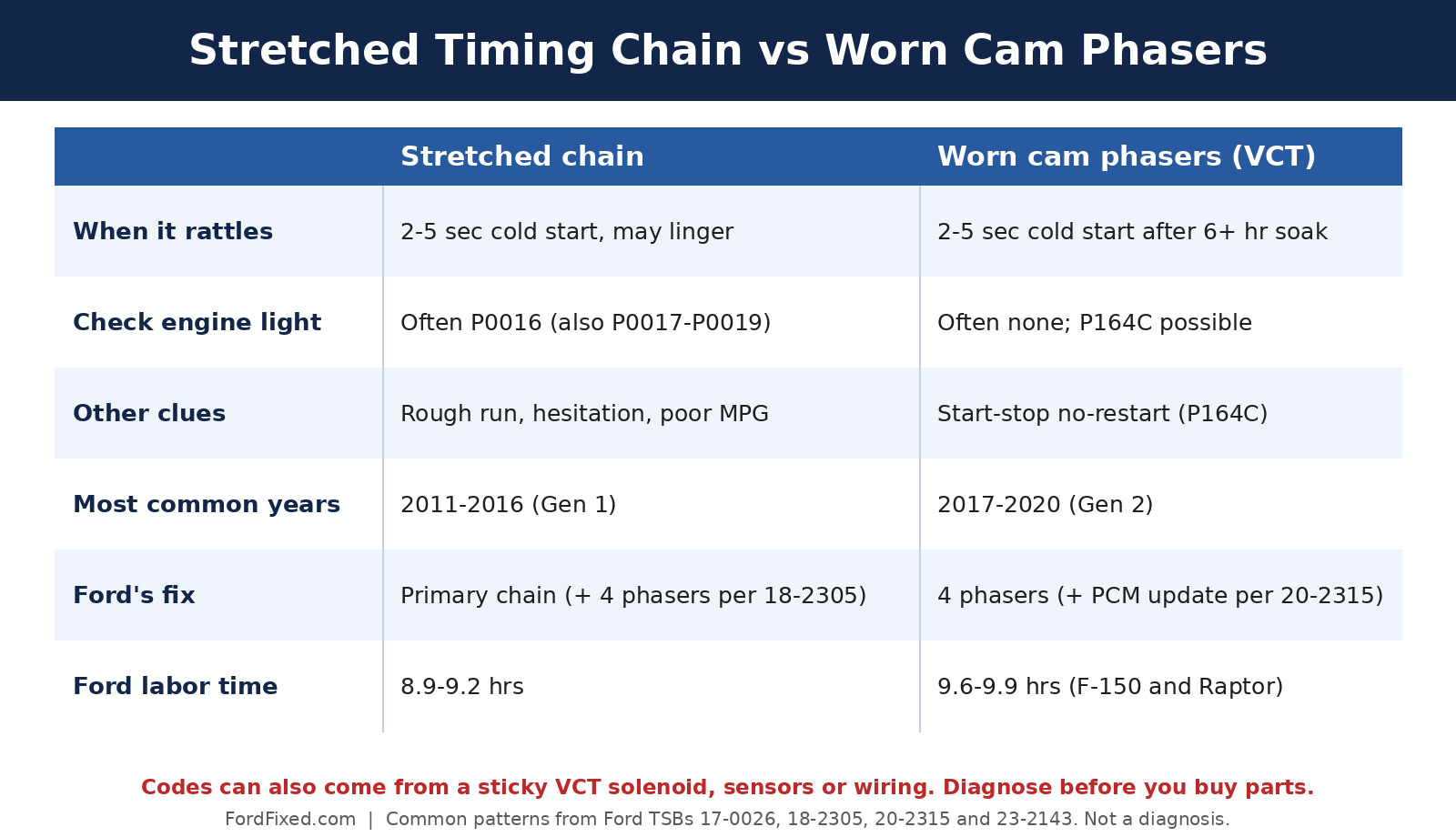
Your ears can tell you something is loose. They can’t tell you which part. Here’s what separates the two in the real world:
- Check engine light with P0016 (or P0017, P0018, P0019). These are cam-to-crank correlation codes. On a first-gen engine, that’s the classic sign of a stretched chain. On any engine they can also come from a sticky VCT solenoid, a sensor or wiring, so they’re a lead, not a verdict.
- Rattle with no codes at all, on a 2017-2020. That’s the textbook worn-phaser pattern. Lots of these trucks never set a light.
- Auto start-stop failing to restart, maybe with P164C. Ford ties that to worn phasers on 2017-2020 trucks in TSB 23-2143.
- Noise that hangs around for longer than a few seconds, or gets louder over time. Get it looked at sooner rather than later, especially on a first-gen truck.
If you like to dig in yourself, a plain code reader is a start, but a tool that shows live cam timing data is better. A lot of Ford owners use FORScan on a laptop with an OBDLink EX FORScan adapter. That lets you read stored codes and watch the VCT data that Ford techs use. For reference, TSB 17-0026 has the tech check the VCT_INT_ACT1 reading with the engine running, and a reading of +6 degrees or more points to chain wear. Treat that as a clue to bring to your shop, not a reason to start pulling the front cover on a Tuesday night.
Step one: check your build date
Model year alone isn’t enough. Every one of these bulletins is keyed to a build date. Open the driver door and look at the sticker on the door jamb (the Safety Compliance label). The month and year of manufacture are printed near the top. Then:
- 2011-2015 F-150 built on or before May 29, 2015: TSB 18-2305 (chain plus phasers) may apply.
- 2011-2014 F-150 built on or before Oct 10, 2014 with P0016: TSB 17-0026 (chain) may apply.
- 2016 F-150: no cold-start bulletin. Normal diagnosis.
- 2017-2020 F-150 built on or before Nov 30, 2019: the phaser bulletins (20-2315, then 23-2143) may apply.
- Later 2020 builds and 2021-up: built after the production fix, so the bulletins don’t apply.
Any Ford dealer can run your VIN and tell you which bulletins, programs or recalls match your truck. You can also check recalls yourself at NHTSA.gov/recalls.
Will Ford pay for it?
Here’s the part nobody likes. A TSB is not a recall. It’s a set of repair instructions for dealers. Ford’s bulletins say the repair is eligible under the New Vehicle Limited Warranty (and, on the newer one, extended service plans and other coverage), and that a TSB doesn’t change warranty limits. So if your truck is still inside its powertrain coverage or you have a Ford ESP that covers engine timing parts, ask the dealer to check. If you’re out of coverage, you’re usually paying.
Ford did run an extended coverage program for 2017-2020 phasers, Customer Satisfaction Program 21N03, which covered a share of the repair based on mileage. According to a write-up of Ford records by Texas Engine Finder, that program ended January 1, 2023. It’s worth asking anyway if a previous owner had work done under it, because that repair order is gold when you sell.
What the repair costs
I’m not going to make up a dollar figure, because shop rates vary wildly. What I can give you is Ford’s own labor time from the bulletins, which tells you the size of the job:
- 2011-2014 F-150, phasers plus primary chain: 9.2 hours (TSB 18-2305)
- 2015 F-150, phasers plus primary chain: 9.0 hours (TSB 18-2305)
- 2011-2014 F-150, primary chain only for P0016: 8.9 hours (TSB 17-0026)
- 2017-2020 F-150, all four phasers: 9.6-9.7 hours (TSBs 23-2143 and 20-2315), 9.7-9.9 on a Raptor
Multiply by your local shop’s hourly rate and add parts, gaskets, fluids and the PCM update, and you’ll see why this is a “sit down before you read the estimate” kind of repair. Independent shops may quote different hours, so get it in writing.
Can you keep driving it?
For the phaser rattle on 2017-2020 trucks, Ford’s service message says the condition does not affect long-term durability or performance, and TSB 20-2315 tells dealers that customers should keep driving while parts are on backorder. So a brief cold-start rattle on a newer truck usually isn’t a “park it now” emergency.
A first-gen truck with a stretched chain is a different animal. Once the chain is loose enough to set P0016 and change how the engine runs, it’s not something to ignore for another year. Chains don’t heal themselves, and when timing goes far enough, the repair bill gets bigger, not smaller.
Prevention: oil is cheap, timing jobs are not
Both of these problems live and die by oil. The phasers and the chain tensioner run on engine oil pressure, and a chain wears faster in dirty oil. You can’t undo wear that’s already there, but you can stop making it worse.
- Use the right oil. Ford specifies 5W-30 for the 3.5 EcoBoost. Our guide to the best oil for a 13th-gen F-150 covers the details, and our chart of recommended oil and filters for every Ford from 2013-2023 has the capacity and filter numbers. The Motorcraft 5W-30 Synthetic Blend (XO-5W30-Q1SP) is the factory fill, and it’s the same oil Ford lists in its own timing bulletins.
- Use a good filter. The Motorcraft FL-500-S oil filter (Ford part AA5Z-6714-A) is the filter Ford lists in TSB 20-2315. A cheap filter with a weak anti-drainback valve is the last thing a phaser wants on a cold start.
- Don’t stretch intervals. Follow the Intelligent Oil-Life Monitor at a minimum, and change it sooner if you tow, idle a lot or make lots of short trips. Turbo engines are hard on oil.
- Reset the reminder after each change. If you’ve got a 2009-2014 truck, here’s how to reset the oil service reminder on a 12th-gen F-150.
Doing the timing job yourself?
I’ll be straight with you: this is a 9-plus-hour job for a dealer tech with the special tools and a lift. It involves the front cover, cam holding tools, and on the newer engine a PCM update you can’t do with a basic scan tool. For most owners, this belongs at a shop.
If you’re the type who rebuilds engines for fun, start with the Ford parts in the bulletin for your year, since they’re the updated pieces. For 2011-2016 trucks, aftermarket kits exist too. The Melling 3-1049S timing kit is the catalog match for many 2011-2016 F-150 3.5 EcoBoost trucks (cross-ref Cloyes 9-0738SA). It does not include the intake and exhaust VVT phasers. Confirm the part against your VIN before you order. Cloyes 9-0753S is a GM 3.6 kit and does not fit. Double-check that you have the 3.5 EcoBoost and not the 3.5 or 3.7 non-turbo V6, which share a lot of names in parts catalogs, and confirm whether the kit includes the phasers, because many do not.
Buying a used 3.5 EcoBoost F-150? Use this checklist
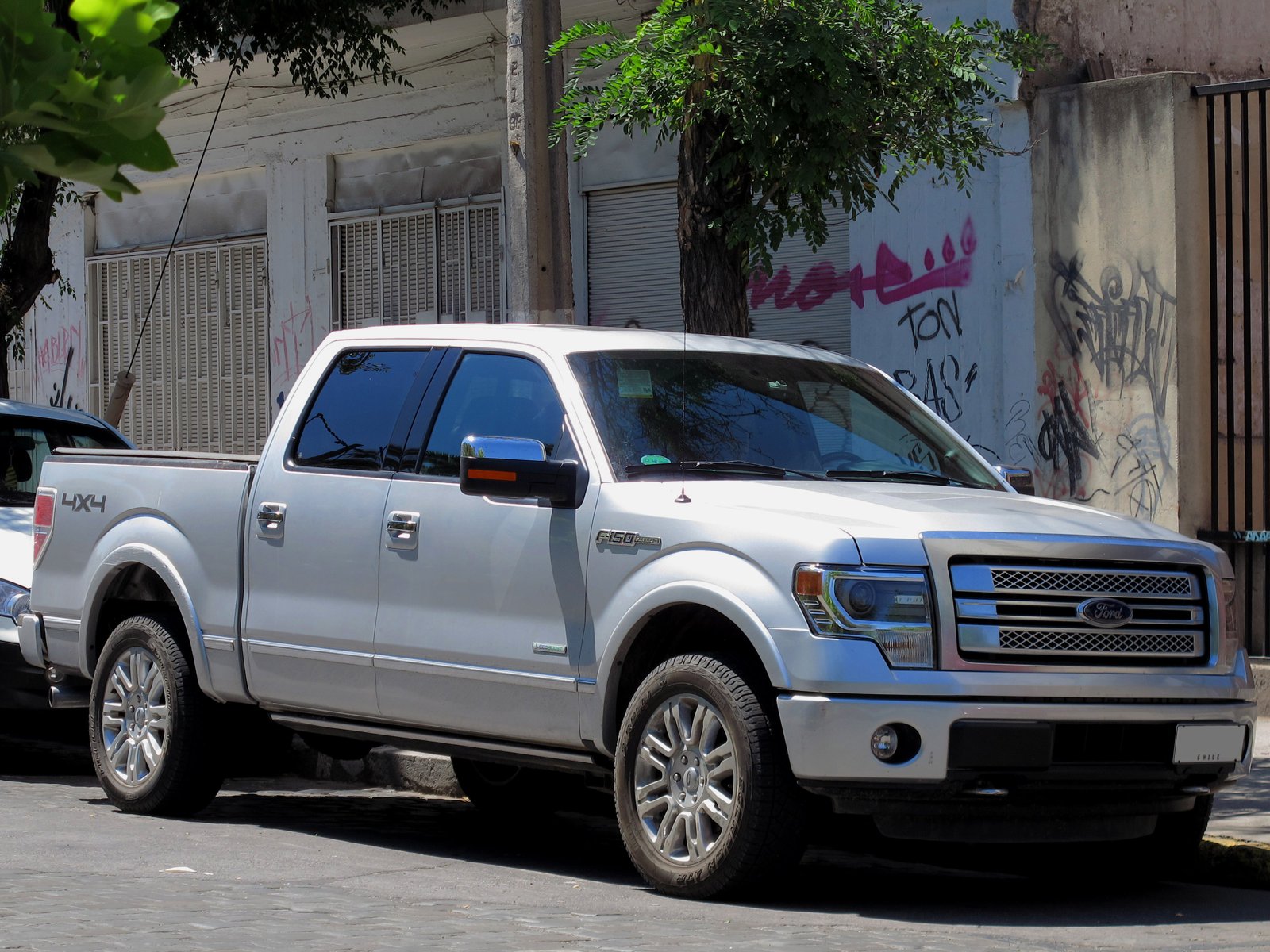
I’m not going to tell you to avoid these trucks. The 3.5 EcoBoost is a strong, torquey engine and there are a lot of happy owners out there. Just go in with your eyes open:
- Insist on a true cold start. Ask the seller not to start the truck before you arrive. Put your hand on the hood when you get there. If it’s warm, someone warmed it up, and you should wonder why.
- Listen for the first 5 seconds. A brief rattle from the front of the engine is the sign you’re looking for. Have a friend stand at the front of the truck while you turn the key.
- Scan for codes. Look for P0016-P0019 and, on 2017-2020 trucks, P164C. Stored or pending codes count.
- Check the build date on the door jamb and figure out which bulletin would apply.
- Ask for paperwork. A dealer repair order showing the four VCT units (and the chain on a first-gen truck) were replaced under a bulletin or 21N03 is a big plus.
- Look at oil change history. Regular changes with the right oil matter more on this engine than the miles on the odometer.
- Budget for it if the noise is there. Use the labor hours above to get a quote, and negotiate accordingly.
Do that, and the worst case is you walk away with a better price instead of a surprise. And hey, at least now you know the difference between a coffee can full of bolts and a coffee can full of money.
Sources
- Ford TSB 18-2305: 3.5L EcoBoost cold start ticking/tapping or rattle, built on or before 29-May-2015 (NHTSA copy, PDF)
- Ford TSB 17-0026: 3.5L GTDI DTC P0016, primary timing chain wear, built on or before 10-Oct-2014 (NHTSA copy, PDF)
- Ford TSB 20-2315: 3.5L EcoBoost cold start rattle, built on or before 31-Oct-2019 (NHTSA copy, PDF)
- Ford TSB 23-2143: 3.5L EcoBoost cold start rattle with possible no restart during auto start-stop, built on or before 30-Nov-2019 (NHTSA copy, PDF)
- Ford SSM 48168: 2017-2018 F-150, 2018-2019 Expedition/Navigator 3.5L EcoBoost cold-soak rattle (NHTSA copy, PDF)
- AERA Technical Committee: Ford 3.5L EcoBoost caution for cam to crank correlation code (PDF)
- Texas Engine Finder: 3.5 EcoBoost problems by year, including Program 21N03 details
This article is for informational purposes. Bulletin coverage depends on your VIN, build date and warranty, so confirm with a Ford dealer. Verify part numbers by VIN and follow a factory service manual for specs and safety procedures. As an Amazon Associate, Ford Fixed earns from qualifying purchases.